
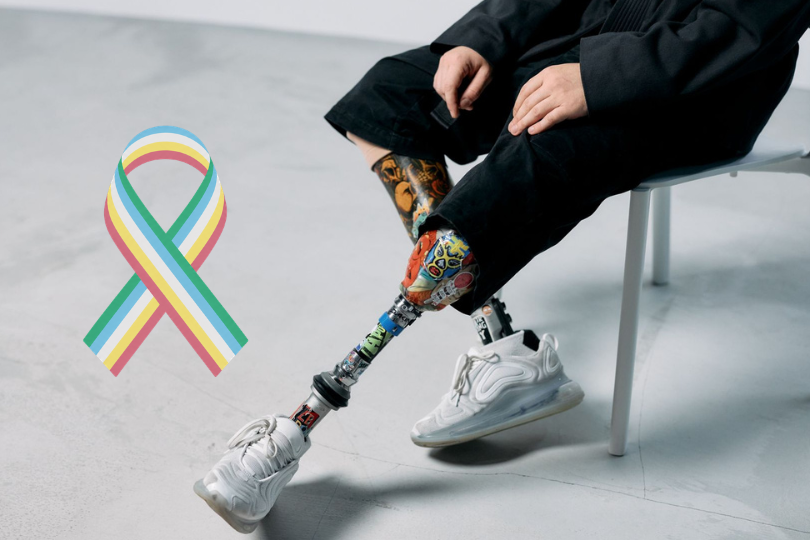
Every July, Disability Pride Month invites us to celebrate disability. Yet for many people, the word pride can feel surprising. After all, pride is usually associated with achievement. We are proud of accomplishments, milestones, and successes. Disability, on the other hand, is often framed through a very different lens—one of limitation, struggle, or adversity.
So why pride?
The answer lies in understanding that Disability Pride Month is not about celebrating pain, barriers, or discrimination. It is about celebrating identity, dignity, and belonging in a world that has historically encouraged disabled people to hide parts of themselves.
For generations, disability was treated primarily as an individual problem to be fixed. Medical interventions, rehabilitation, and support services undoubtedly improve lives, but they also contributed to a broader cultural narrative: that disability exists solely within the person. Disability scholars have challenged this perspective for decades, arguing that many disabling experiences arise not from impairments themselves, but from environments, attitudes, and systems that fail to accommodate human diversity. This idea fundamentally changes the conversation.
Consider a wheelchair user unable to enter a building because there is no ramp. The challenge is not simply the wheelchair. The challenge is a society that designed a space without considering everyone who might need to use it.
The same principle applies across countless aspects of everyday life. A website that cannot be navigated by a screen reader excludes blind users. A workplace that assumes all employees can work the same schedule may unintentionally disadvantage people with chronic illnesses. A classroom that values only one style of learning may create unnecessary barriers for neurodivergent students.
In these situations, disability is not solely a characteristic of the individual. It emerges through the interaction between people and environments.
Disability Pride Month encourages us to recognize this reality.
Beyond the Narrative of “Overcoming”
One of the most persistent stereotypes about disability is the expectation that disabled people should either overcome their disabilities or be defined by them. Popular culture often offers only two narratives.
The first is tragedy. The disabled person is portrayed as an object of sympathy, someone whose life is inherently less fulfilling because of their disability.
The second is inspiration. The disabled person becomes a hero for performing ordinary activities or achieving success despite extraordinary obstacles.
Neither story leaves much room for ordinary humanity.
Most disabled people are not trying to inspire strangers. Nor are they seeking pity. They are simply living their lives—working, studying, building relationships, raising families, pursuing passions, and navigating challenges like everyone else.
Disability Pride creates space for a more nuanced understanding. It allows disability to exist as one aspect of a person’s identity rather than the defining feature of their existence. Importantly, pride does not require denying hardship.
The Power of Identity
Research suggests that developing a positive disability identity can have meaningful psychological benefits. Rather than internalizing society’s negative assumptions about disability, individuals who embrace disability as a valued part of their identity often report greater self-esteem and resilience. In particular, Bogart, Lund, and Rottenstein (2018) found that disability pride may help protect self-esteem by reducing the harmful effects of stigma and strengthening a sense of community belonging.
This finding highlights something important: pride is not simply a feeling. It can also be a form of resistance. When people are repeatedly exposed to messages suggesting they are less capable, less valuable, or less deserving of participation, pride becomes an act of self-definition.
It is a way of saying: “I decide who I am—not society’s stereotypes.”
This is one reason disability communities have played such an important role in shaping Disability Pride Month. Shared experiences create opportunities for connection, advocacy, and mutual support. They also challenge the isolation that many disabled people experience, particularly when they rarely encounter others who share similar identities or life experiences.
As disability studies scholar Tom Shakespeare (2013) argues, disability is not merely a medical condition; it is also a social and cultural experience shaped by relationships, institutions, and collective understandings of difference. Seen through this lens, Disability Pride Month is not just about individuals. It is about community.
The Importance of Being Visible
Visibility has always been central to social change. People cannot challenge assumptions about disability if disabled individuals remain absent from public life, leadership positions, workplaces, media representation, and decision-making spaces. Yet visibility requires courage.
For many disabled people, being visible means requesting accommodations without apology. It means using mobility aids in public. It means disclosing a non-visible disability when necessary. It means rejecting pressure to appear “normal” at the expense of well-being.
These actions may seem small from the outside, but they can be profoundly significant. They challenge the belief that inclusion is a special privilege rather than a basic right. They remind us that accessibility is not an act of charity. It is an essential component of equity. And they demonstrate that diversity includes disability as a natural and valuable part of human society.
A Celebration for Everyone
Disability Pride Month is often perceived as a celebration for a specific group of people. In reality, its message reaches much further. Disability is one of the few identities that anyone can acquire at any point in life. Through illness, injury, aging, or changing circumstances, disability is an experience that touches nearly every family and community. It does not concern only a small minority.
Instead, disability reminds us of something universal—that human beings are interconnected. Every person depends on others in different ways throughout life. Some forms of dependence are simply more visible than others. Recognizing this truth can foster empathy, improve accessibility, and strengthen communities for everyone.
After all, curb cuts help wheelchair users, but they also help parents with strollers, travelers with luggage, and delivery workers moving heavy loads.
Captions support Deaf and hard-of-hearing individuals, but they also benefit language learners and people watching videos in noisy environments.
Designing for inclusion rarely helps only one group. More often, it creates a better world for everyone.
Taking Up Space
Perhaps the most powerful message of Disability Pride Month is also the simplest.
Disabled people do not need to earn their right to belong.
They do not need to hide their differences to be accepted.
Pride, in this context, is not about claiming superiority. It is about rejecting shame.
In a culture that often encourages people to conceal the parts of themselves that seem different, Disability Pride Month offers a radical alternative:
Be visible. Be heard. Take up space.
You belong here.
Recommended readings:
Bogart KR, Lund EM, Rottenstein A. Disability pride protects self-esteem through the rejection-identification model. Rehabil Psychol. 2018 Feb;63(1):155-159. doi: 10.1037/rep0000166
Oliver, M. (1990). The Politics of Disablement. London, UK: Macmillan.
Shakespeare, T. (2013). Disability Rights and Wrongs Revisited (2nd ed.). London, UK: Routledge.

Leave a Reply
You must be logged in to post a comment.